

Why profit alone is no longer enough.
What constitutes true success for a company today?
In the past, success was measured by profit on the balance sheet or growth compared to the previous year. However, by 2026, this question will be asked in a fundamentally new way. The world has become more complex, with crises, climate change, geopolitical uncertainties, and demands for social justice requiring a new mindset at all levels. Today, companies are under pressure to succeed financially and to take responsibility for the environment, society and their employees.
Success is no longer one-dimensional.
Traditional corporate management tools such as the balanced scorecard or gross domestic product are inadequate for understanding economic reality in its totality. Now, it's about resilience rather than just returns. It's about trust instead of just contracts. It's about sustainability instead of quarterly figures.
This three-part report highlights how modern companies and countries are redefining success in a scientifically proven, data-driven, practical way.
The limits of traditional performance measurement
Introduced by Kaplan and Norton in the 1990s, the Balanced Scorecard (BSC) expanded business performance measurement to include non-financial factors such as internal processes, customer feedback, and learning and growth. It facilitated the systematic realisation of strategies and was the standard in corporate management for a long time.
However, this instrument is no longer sufficient. The BSC does not map environmental impacts, only considers social responsibility indirectly, and leaves governance issues untouched. In an era marked by ecological crises, social inequalities and corporate ethics scandals, BSC models are increasingly reaching their limits.
ESG criteria offer a comprehensive assessment framework.
ESG stands for 'Environmental, Social and Governance' and establishes a systematic, international standard for non-financial corporate transactions.
A growing number of companies, investors, and regulators use ESG data to evaluate business risks and long-term prospects.
Environmental factors: carbon footprint, energy consumption, resource efficiency and biodiversity.
Social: working conditions, equality, human rights, and social commitment.
Governance: corporate ethics, transparency, compliance, and management structure.
A 2024 ZHAW study shows that 43% of Swiss companies already carry out ESG reporting. A shortage of specialists and an unclear methodology were cited as key challenges. Nevertheless, the trend is clear: ESG is becoming the new norm. (ZHAW, 2024).
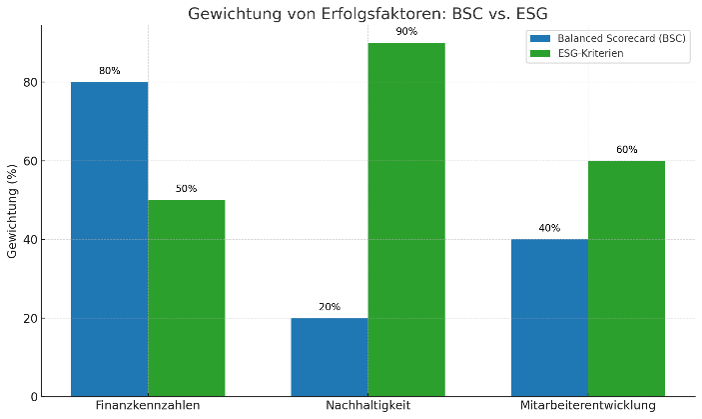
Visualisation: Comparing BSC and ESG criteria
This bar chart illustrates the different weightings of success categories in the BSC compared to ESG standards. While the BSC primarily focuses on financial indicators, the ESG framework significantly increases the importance of social and environmental factors.
Financial metrics: BSC: 80%; ESG: 50%.
- Sustainability: BSC: 20%; ESG: 90%.
- Employee development: BSC: 40%; ESG: 60%.
Why does ESG make economic sense?
ESG is not just an ethical or regulatory issue — it also pays off in business terms. According to a 2022 study by Harvard Business School, companies with a high ESG rating are more resilient to market fluctuations, benefit from better access to capital and achieve higher long-term returns.
Furthermore, the logic of the capital markets is evolving, with major institutional investors such as BlackRock and Swiss pension funds increasingly demanding ESG-compliant behaviour and threatening to withdraw capital if compliance is not met.
Conclusion, Part 1: The Balanced Scorecard was an important milestone. However, ESG is the next stage, offering a more comprehensive and relevant approach that is better suited to the future. If companies want to measure success in the 21st century, they must consider environmental, social and governance factors.


